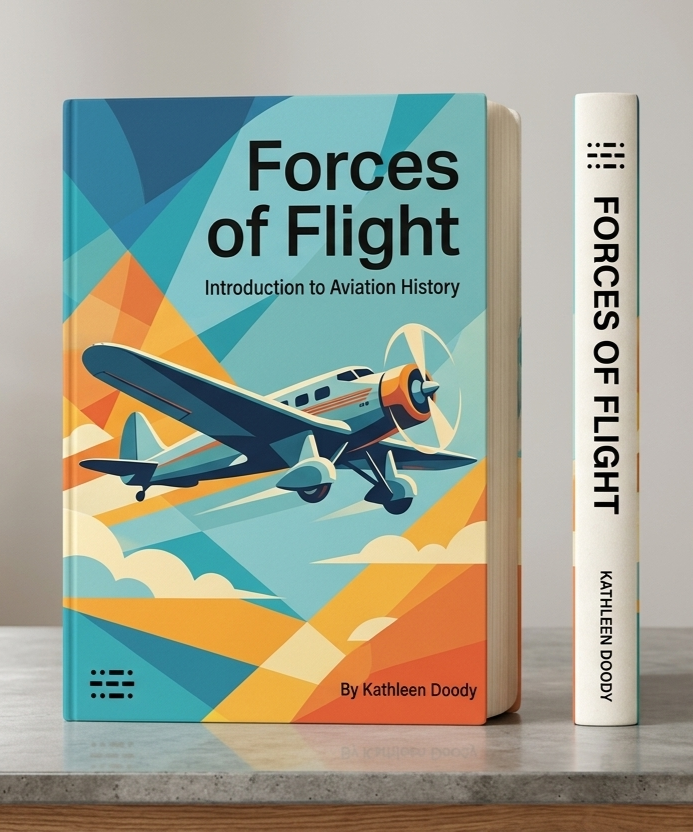
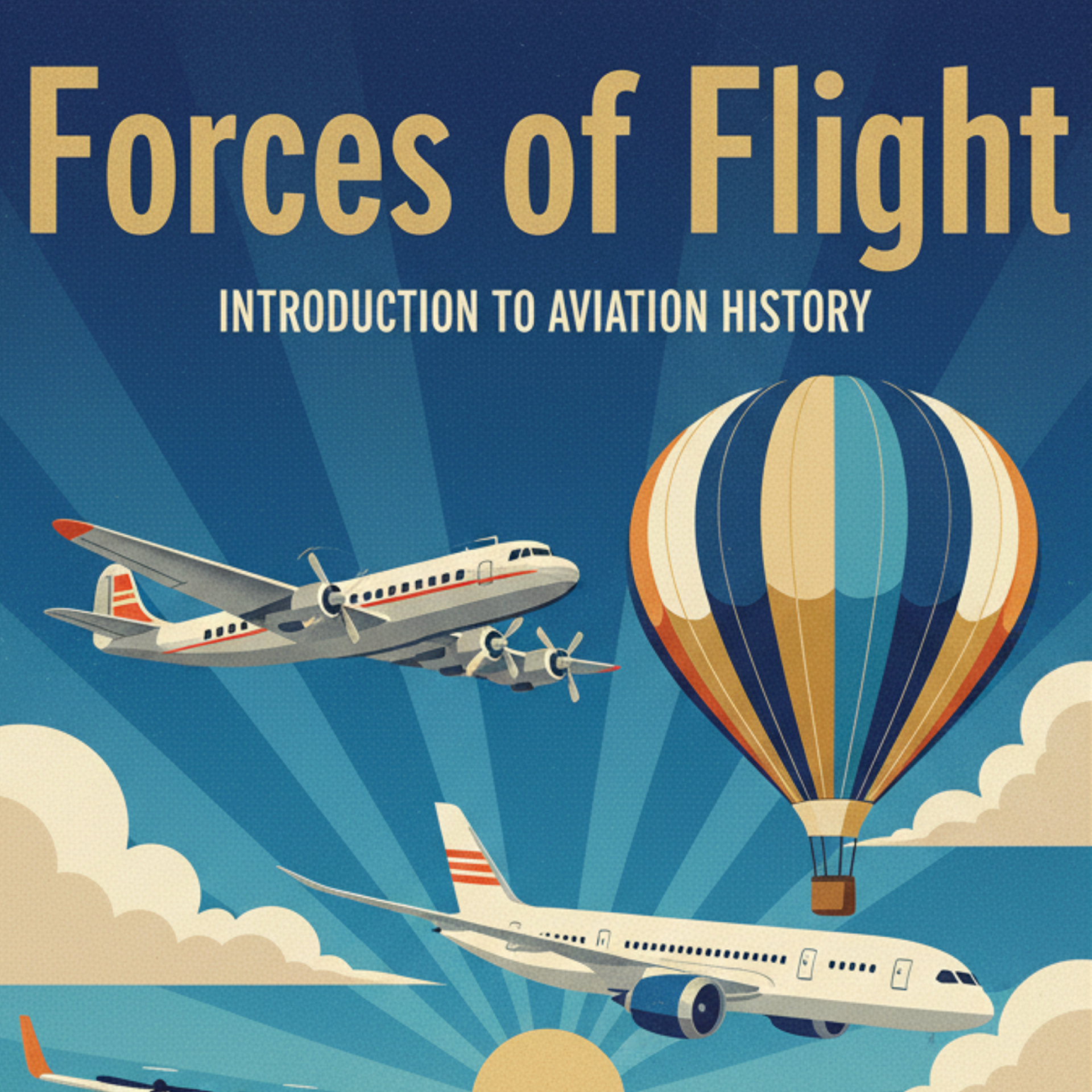
Forces of Flight
Introduction to Aviation History
A modern, comprehensive textbook designed to meet the needs of today’s aviation students and educators.
Download the textbook for $75 ↓
Forces of Flight offers a comprehensive and accessible history of aviation—from early imagination and experimentation to today’s innovations in space travel and unmanned systems. Written to serve flight students, high school to university audiences, andindependent learners of all ages, this text is for anyone who has a curiosity and enthusiasm for flight!
Forces of Flight blends historical narrative with technological advancement, policy development, and social context to provide a holistic understanding of how aviation became the global system we know today.
Written with clarity, depth, and contemporary relevance, Forces of Flight emphasizes the connections between past innovations and the challenges and opportunities facing the aviation industry today.
This book is for:
Undergraduate aviation students
Pilots and aviation professionals
Aerospace and engineering learners
Educators seeking an updated, interdisciplinary text
Lifelong learners with an interest in flight
Key themes:
Origins of flight
Technological evolution
Global air transport systems
Policy, regulation, and economics
Labor and workforce development
Societal impacts
Environmental sustainability
Future trends
Unmanned systems
Spaceflight
Table of Contents
-
Chapter 1: Flight Before the Airplane
Long before the airplane, inventors had to discover what air was and how it could be used to support flight. This chapter follows the progression from balloons and dirigibles to gliders, introducing the physical principles that made flight possible and showing how each successful innovation revealed the next problem that aviation pioneers would have to solve.
Chapter 2: The Wrights and the Problem of Control
The challenge of powered flight was not simply getting an aircraft into the air—it was controlling it once it was there. This chapter follows the work of Lilienthal, Chanute, and especially Wilbur and Orville Wright as experimentation with lift, propulsion, wind-tunnel testing, and three-axis control culminated in the Wright Flyer and the first successful powered, controlled flight.
Chapter 3: Aviation in World War I
World War I transformed the airplane from an experimental invention into a practical and increasingly specialized machine. This chapter traces the rapid expansion of military aviation from reconnaissance to combat, the technological advances produced by wartime investment, and the surplus of aircraft and trained pilots that helped propel aviation into civilian life after the war.
Chapter 4: Interwar Airmail to World War II: Building the Modern Aviation System
Between the world wars, airmail forced aviation to become scheduled, reliable, navigable, and professional, while World War II dramatically expanded the scale and capabilities of the system that had emerged. This chapter connects airmail routes, navigation, night and instrument flying, and federal policy to wartime advances in aircraft, radar, production, and personnel, showing how the foundations of modern aviation were built across these two closely connected periods.
-
Chapter 5: From Spectacle to System: Postwar Passenger Aviation
After World War II, aviation moved decisively from spectacle and luxury toward an increasingly important form of mass transportation. This chapter explores the transition from piston airliners to jets, the expansion of airports and scheduled service, and the technological, economic, and cultural changes that made commercial aviation a defining feature of the postwar world.
Chapter 6: Regulating the Air: CAB, CAA, FAA, DOT, and NTSB
As aviation grew, the federal government developed an increasingly complex system for managing its safety, economics, infrastructure, and airspace. This chapter explains the evolving responsibilities of the CAB, CAA, FAA, DOT, and NTSB and shows how regulation developed in response to the demands of an increasingly busy and interconnected national aviation system.
Chapter 7: Airline Economics Before Deregulation
For much of the twentieth century, the federal government controlled where airlines could fly, what markets they could enter, and what fares they could charge. This chapter examines how that regulated economic system shaped airline competition, labor, passenger access, and the cost of flying—and why growing criticism of its limitations ultimately created pressure for deregulation.
Chapter 8: Aviation and the Cold War
During the Cold War, aviation became both an instrument of geopolitical power and a highly visible measure of technological achievement. This chapter explores advances in bombers, fighters, reconnaissance, surveillance, missiles, and supersonic flight while tracing the parallel development of commercial jet aviation and the increasingly global air transportation system.
-
Chapter 9: Deregulation
The Airline Deregulation Act of 1978 fundamentally changed the rules governing the American airline industry. This chapter examines the forces behind deregulation, the legislation that dismantled federal economic controls, and the turbulent period of new competition, airline failures, mergers, route restructuring, and expanding passenger access that followed.
Chapter 10: Markets, Labor, and the Hub-and-Spoke System
Deregulation did not eliminate structure from the airline industry—it created new forms of it. This chapter explains the rise of hub-and-spoke networks, fortress hubs, low-cost carriers, codesharing, and alliances while examining how new competitive pressures reshaped airline business models, labor relations, and the relationships among airlines, passengers, employees, and government.
Chapter 11: Modern Open Skies and Global Air Governance
Commercial aviation crosses national borders, but the airspace above those nations remains bound to questions of sovereignty, diplomacy, and economic competition. This chapter examines the Freedoms of the Air, bilateral agreements, Open Skies agreements, and ICAO while showing how domestic deregulation became part of a broader movement toward increasingly liberalized global air transportation.
-
Chapter 12: Aviation in Crisis: September 11, 2001
The terrorist attacks of September 11, 2001, produced an unprecedented crisis for the American aviation system. This chapter traces the immediate operational response and examines how the attacks exposed vulnerabilities in aviation security, disrupted airlines and airports, altered public perceptions of flight, and prompted fundamental changes in the relationship between civil aviation and national security.
Chapter 13: Flying in the Security Age
The emergency response to September 11 evolved into a permanent new security architecture for American aviation. This chapter examines the federal agencies, laws, screening procedures, and security responsibilities created in the years after the attacks and explains how these changes transformed airports, passenger routines, and the relationships among travelers, airlines, airports, and the federal government.
Chapter 14: Consolidation, the Passenger Experience, and Reform
The decades following deregulation and September 11 reshaped both the airline industry and what passengers experienced when they flew. This chapter traces bankruptcies, mergers, consolidation, low- and ultra-low-cost business models, fare unbundling, ancillary fees, and loyalty programs while examining the passenger backlash and government reforms that accompanied those changes.
-
Chapter 15: Drones, Automation, and the Changing Meaning of Flight
Drones have opened aviation to millions of people who may never enter a cockpit while challenging traditional assumptions about aircraft, pilots, operators, and airspace. This chapter explores the growth of civilian drone use, the safety, privacy, and regulatory questions it has created, and the broader democratization of participation in flight.
Chapter 16: Aviation in Crisis: COVID-19 and Industry Disruption
The COVID-19 pandemic brought global aviation to an extraordinary disruption and exposed the vulnerabilities of a system dependent on enormous capital investment, specialized workers, and continuous passenger demand. This chapter examines airline survival strategies, government assistance, workforce and training disruptions, and the uneven recovery while comparing the pandemic with September 11 as a major system-wide aviation crisis.
Chapter 17: Unmanned Aerial Systems (UAS), Warfare, and Civilian Integration
Unmanned aircraft have changed both military operations and the boundaries of civilian aviation. This chapter examines how remotely piloted systems have altered the conduct and political consequences of warfare while exploring the difficult task of integrating rapidly proliferating unmanned aircraft into an airspace system originally designed around human pilots and conventional aircraft.
Chapter 18: Technological Frontiers: Supersonic Return, Suborbital Flight, and Sustainability
Aviation’s newest technological ambitions are shaped not only by what engineers can make fly, but also by economics, environmental constraints, regulation, and public demand. This chapter examines efforts to revive supersonic passenger travel, the emerging boundary between aviation and suborbital spaceflight, and technologies intended to reduce aviation’s environmental impact as the industry confronts new economic and social responsibilities.
Chapter 19: Off-World: Ingenuity and the Future of Flight
NASA’s Ingenuity Mars Helicopter became the first aircraft to achieve powered, controlled flight on another planet, flying within the thin atmosphere of Mars rather than traveling through space. This chapter examines how engineers had to solve the familiar problems of lift, weight, thrust, and drag under radically unfamiliar atmospheric conditions, demonstrating that the fundamental forces of flight still apply even when the environment changes. From the Wright Flyer’s first powered, controlled flight on Earth to Ingenuity carrying a small piece of that aircraft into flight on Mars, the story brings aviation history full circle while pointing toward an entirely new frontier for aircraft and flight.
Chapter 20: What Comes Next? The Continuing Forces of Flight
Aviation history does not end at the present because the very forces that have shaped flight from its beginnings are still at work. This concluding chapter looks forward by asking readers to recognize recurring patterns across aviation history: new technologies create new possibilities and new problems, crises accelerate change, governments and markets shape what becomes practical, and each solved problem reveals another waiting beyond it. This chapter invites readers to draw upon their knowledge of aviation history to understand and participate in the next chapter of flight.
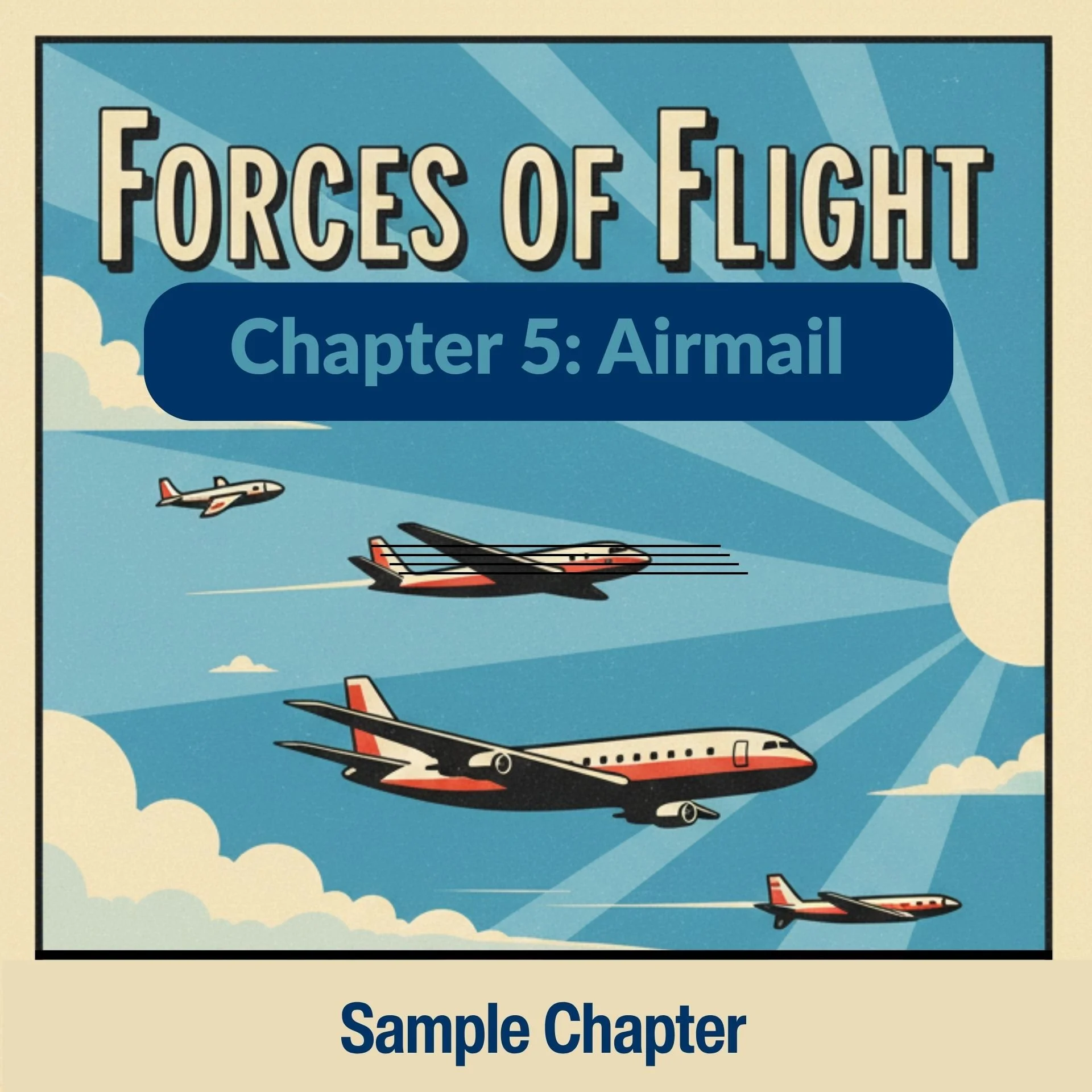
Download a sample chapter for just $1 ↓
Companion Courseware
The textbook is supported by an extensive digital library of companion materials including:
Video Lectures
Slide Decks
Timelines & Maps
Reading Companions
Assignments & Activities
COMING SOON
Forces of Flight
Secondary Education Adaptation for middle school and high school students
This edition is designed for classroom adoption, extracurricular instruction, and home school use.
Robust instructor guidance including supporting materials, student courseware, and online support will allow for simple adoption and effective use.