
Not a Screw
So Why Did They Call It an Airscrew?
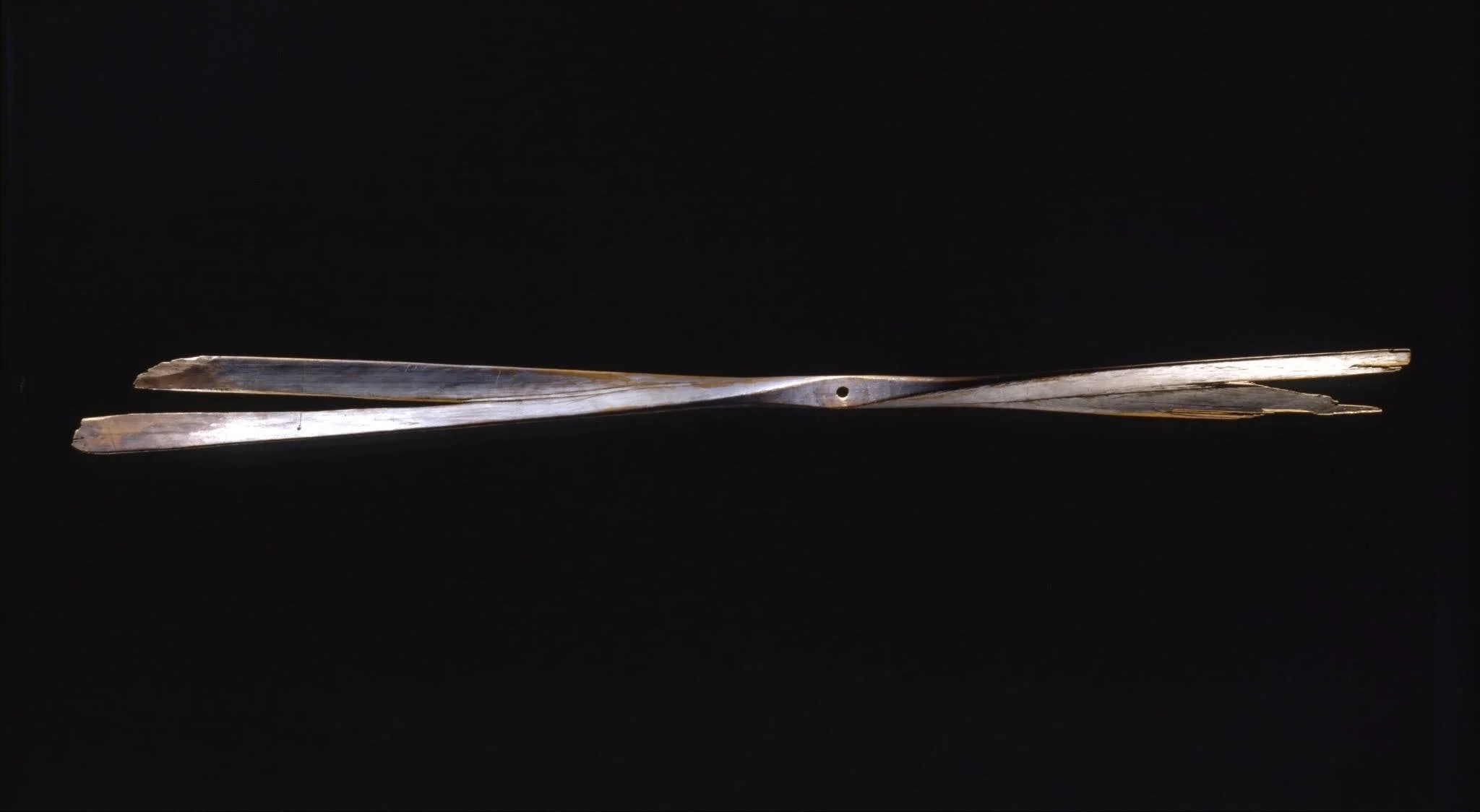
Original propeller from the 1903 Wright Flyer, 1903. Photo by Eric Long, Smithsonian National Air and Space Museum. CC0/Open Access.
The airscrew is older than the airplane. Long before Orville and Wilbur Wright reached Kitty Hawk, inventors had borrowed the screw propeller from ships and tried to make versions of it work in the air. The terminology came with the technology. But when the Wrights confronted the problem for themselves, they came to see that the better aerodynamic model was not the screw—it was the wing. A propeller blade was an airfoil following a helical path through the air.
By 1902, the Wrights had worked their way through many of the problems that had defeated earlier attempts at powered flight. Their wind-tunnel experiments had given them aerodynamic data they trusted, and they had developed a practical system for controlling an airplane in three axes. Propulsion seemed as though it ought to be the easier problem. After all, screw propellers had been pushing ships through water for decades. Surely someone had already figured this out.
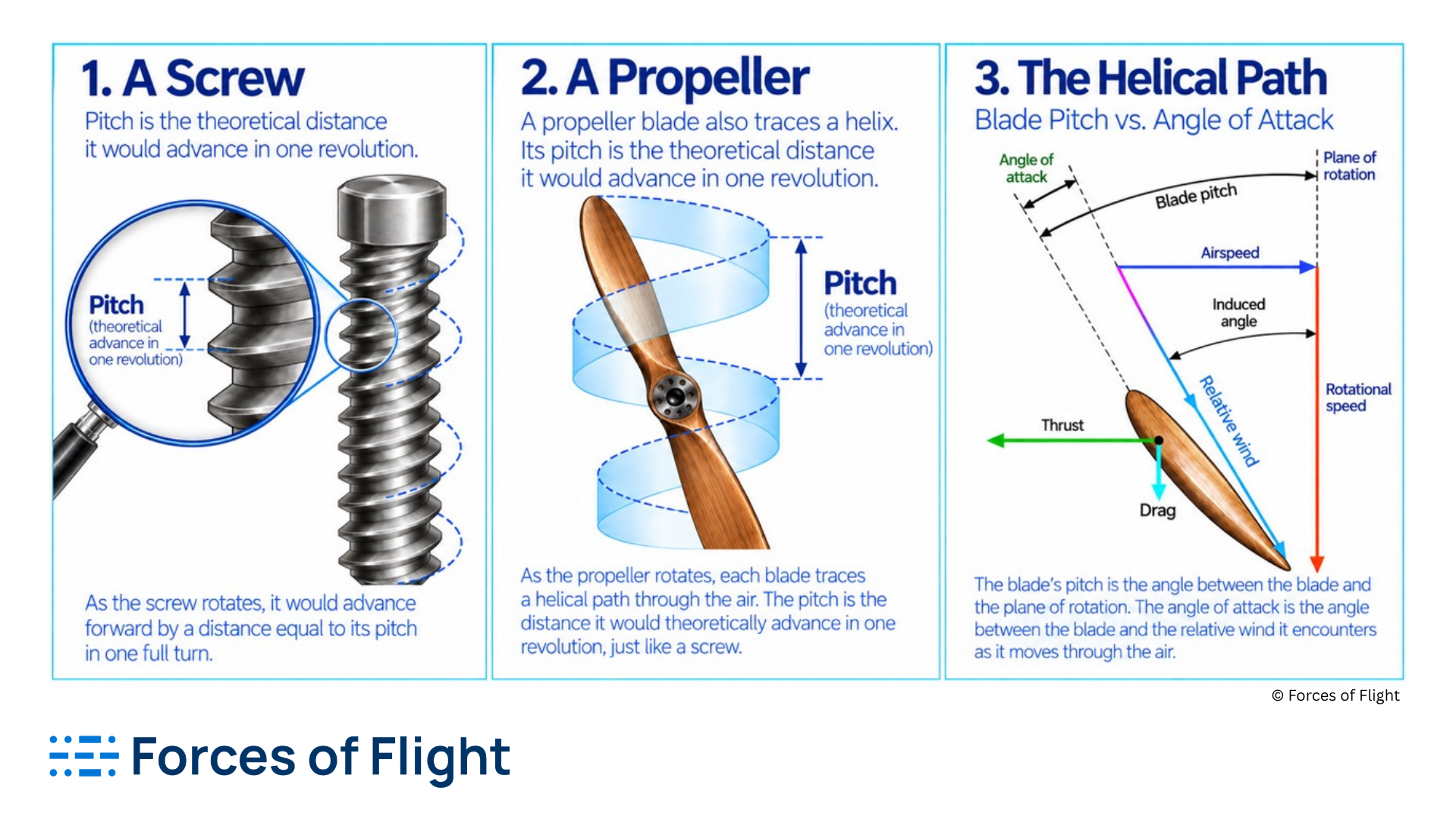
The screw analogy itself was perfectly sensible. A screw advances as it rotates, and the distance it would theoretically advance in one revolution is described by its pitch. A propeller rotating while an airplane moves forward has similar geometry: its blades trace helical paths through the air, and pitch likewise describes how far the propeller would theoretically advance in one revolution. That is different from angle of attack: pitch describes the blade’s geometric relationship to its theoretical helical path, while angle of attack describes the angle between the blade and the relative airflow it encounters. The term airscrew survived because it describes this geometry, but what the screw analogy cannot do is adequately explain propeller aerodynamics.
The Wrights discovered that limitation when they went looking for the theory they expected marine engineering to provide. Their plan was straightforward: find the formulas governing marine propellers, substitute the known pressures of air for those of water, and design an aerial version. Instead, they found that roughly a century of practical experience with marine propellers had produced plenty of empirical knowledge but surprisingly little theory that could simply be transferred to an airplane. In their own account, the Wrights described the action of the screw propeller as still “very obscure.”
So they returned to something they did understand: wings.
The Wrights later summarized the insight with wonderful economy: “screw-propellers are simply wings traveling in a spiral course.” The sentence makes their conceptual leap sound almost obvious—although it wasn’t.
A wing moving through air generates an aerodynamic force. A propeller blade does the same thing, except that it rotates rather than traveling straight ahead with the airplane. Properly oriented, the useful component of that aerodynamic force becomes thrust. The Smithsonian describes the Wrights’ conception as a “rotating, twisted wing moving in a helical path.” Their wind-tunnel experiments had already given them airfoil data; now they could apply that knowledge to calculating the shape of a propeller rather than simply carving one by trial and error.
The twist in the blade is part of what makes the idea visible. A point near the hub travels around a relatively small circle during each revolution, while the tip travels around a much larger one in exactly the same amount of time. The tip therefore moves much faster. Although a propeller blade appears to be one continuous aerodynamic surface, different sections along its span are moving at different rotational speeds and encountering different relative airflow. Its shape and angle must change accordingly from root to tip.
The result was remarkably good. The propellers on the 1903 Wright Flyer achieved about 66 percent efficiency, according to the Smithsonian and National Park Service. NPS compares that figure with approximately 40 to 50 percent for some earlier European propellers and 52 percent for Samuel Langley’s. What had initially looked like a problem the Wrights could borrow from marine engineering instead became one of their most original pieces of aerodynamic work. But the Wrights’ breakthrough raises a question. If they had realized that a propeller was aerodynamically a wing, why did they keep calling it a screw?
In the very account in which Wilbur and Orville explained that propellers were wings traveling in a spiral course, they repeatedly referred to “screw-propellers.” They also used “air-propellers” and discussed why there could be no single “best” screw suited to every aircraft and operating condition. Their aerodynamic breakthrough did not make the old vocabulary disappear.
Nor did airscrew become an embarrassing relic used only by people who had failed to understand the new science. In 1913, The Aeronautical Journal published a technical paper titled simply “Airscrews.” The word became ordinary aviation vocabulary, particularly in Britain, and remained in use long after propeller theory had moved beyond any notion of a screw literally boring its way through the atmosphere.
Even Wolfgang Langewiesche’s classic 1944 flight-training book Stick and Rudder invoked the comparison, telling readers to think of “a propeller itself, if you like, by comparison with a screw.” By then, the screw was certainly not a complete aerodynamic explanation, but it didn’t need to be in order to be useful. The comparison survived because it captured something real about the propeller’s motion.
The geometry of the screw describes something real: rotation, pitch, advance, a helical path. What it cannot adequately explain is why a shaped blade moving through air produces thrust. For that, the Wrights needed the aerodynamics of the wing. The screw wasn’t an entirely incorrect analogy. It just wasn’t enough.
There is a larger pattern here, and it extends well beyond propellers. Human beings make unfamiliar things intelligible by comparing them with things they already know. Sometimes those comparisons are remarkably productive. The trouble begins when a useful analogy quietly becomes an explanation—and nobody notices where the resemblance ends.
The Wrights did not have to throw away the screw to understand the propeller. They had to recognize which part of the old idea to keep. The screw remained a useful analogy; the wing became the better aerodynamic model.
The name airscrew survived because the screw image still described something real about the propeller’s motion. It just couldn’t explain how the propeller worked on the air.
Not a screw, then. But not such a bad analogy.