
Why Is O’Hare ORD?
History in Airport Codes
Book a flight from Denver to Chicago and your itinerary looks perfectly sensible at first. You leave DEN and arrive at ORD.
DEN is easy. Denver. But ORD?
Chicago’s airport is O’Hare International Airport. There is no R in O’Hare. There is no D. If airport codes are abbreviations, ORD appears to be doing a rather poor job of it.
Except ORD isn’t an abbreviation for O’Hare. It is an abbreviation for a place that O’Hare used to be.
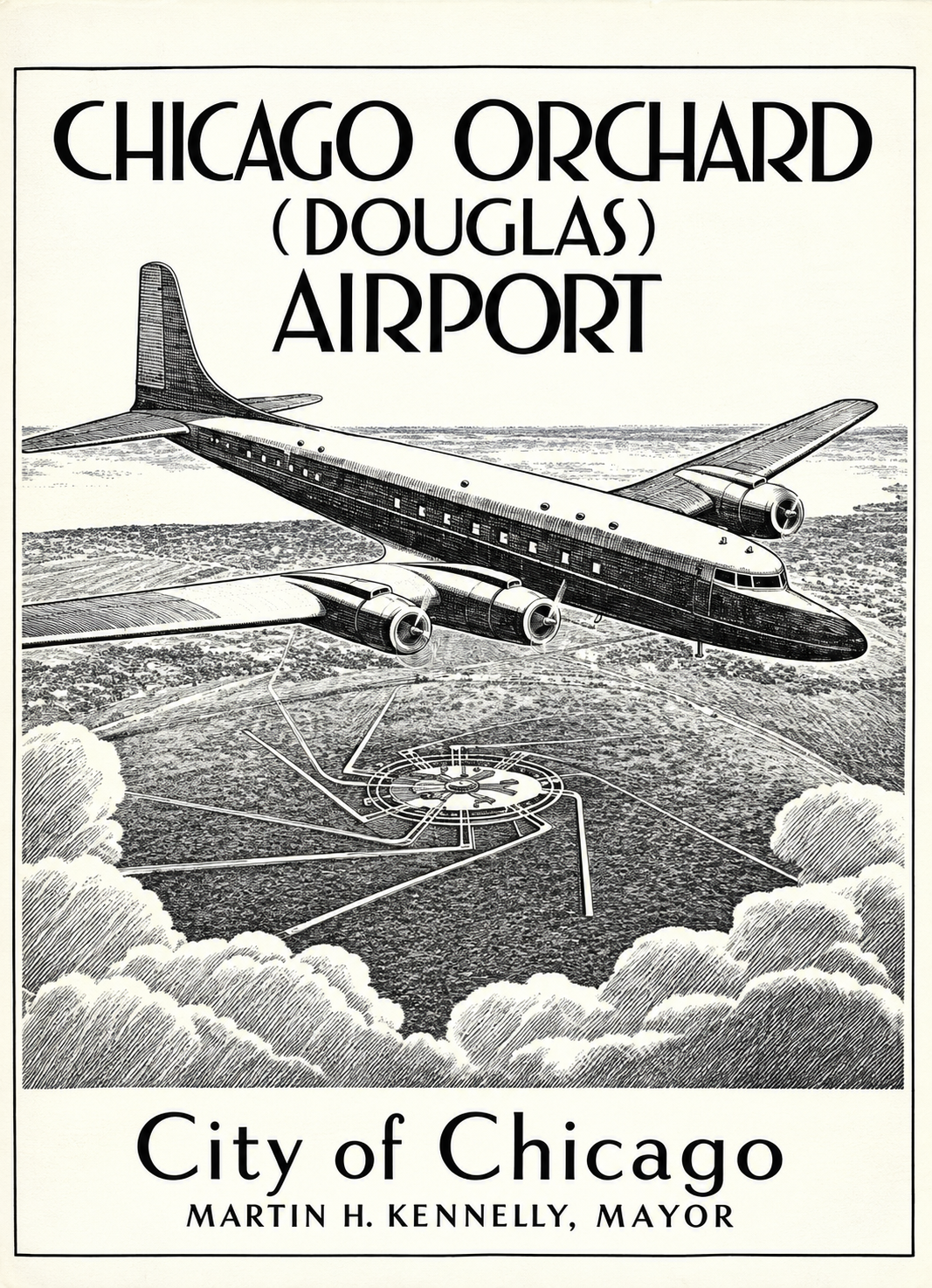
Before O’Hare was O’Hare, it was Orchard Field. The site northwest of Chicago had been home to a Douglas aircraft assembly plant during World War II, and in 1945 the city selected it for development as a new airport. Its identifier, ORD, came from the Orchard Field name. In 1949, the airport was renamed for Lieutenant Commander Edward “Butch” O’Hare, the U.S. Navy fighter pilot and Medal of Honor recipient who was lost in combat during World War II.²
The name changed. The code did not.
That seems unusual only because so many airport codes have trained us to think of them as abbreviations. Denver is DEN. Boston is BOS. Atlanta is ATL. When the letters line up neatly with the city, we barely notice them.
But airport codes were not created primarily to help passengers play a three-letter geography game. They are identifiers used throughout air transportation—in schedules, reservations, ticketing, baggage handling, cargo operations, and all the other places where everyone needs to agree that three particular letters mean one particular place.¹
The system has roots in the early days of commercial aviation. Airlines were using two-letter identifiers in the 1930s, but as aviation expanded, so did the number of places needing codes. By the late 1940s, two letters no longer provided enough combinations, and the industry moved toward three. That transition left behind a different kind of historical artifact: Los Angeles, once LA, became LAX in 1947.¹
Most of the time, the resulting three letters make intuitive sense. Sometimes, however, the airport changes faster than its identifier does.
Fly to Orlando, for example, and your bag is tagged MCO.
The letters come from McCoy Air Force Base, the military installation that once occupied the site. McCoy Air Force Base closed in 1974 as the site transitioned fully toward civilian aviation, but MCO remained.³ Millions of travelers now arrive in Orlando carrying a three-letter remnant of the Cold War on their baggage tags.
Nashville offers another variation. BNA stands for Berry Field Nashville, preserving the name of Berry Field, which opened in 1937 in honor of Colonel Harry S. Berry.⁴ Today the airport is Nashville International, but the B in BNA still points backward to Berry.
Then there is New Orleans.
Louis Armstrong New Orleans International Airport is MSY, which gives away almost nothing about where you are going. But MSY may have the best memory of them all.
The letters stand for Moisant Stock Yards.⁵
John B. Moisant was an early American aviator who died in an airplane crash near New Orleans in 1910 while attempting an aviation record. After his death, property near the crash site became cattle stockyards bearing his name: Moisant Stock Yards. When New Orleans later developed an airport nearby, it became Moisant Field.⁵
Then the names kept changing.
Moisant Field became New Orleans International Airport in 1960. In 2001, the airport was renamed again, this time for Louis Armstrong.⁵ The modern passenger sees Armstrong’s name on the terminal while MSY continues to carry Moisant’s.
So three letters on a baggage tag can contain several layers of history: a modern international airport named for one of America’s most famous musicians, carrying an identifier inherited from an earlier airport, whose name leads back through a set of stockyards to an aviator who died more than a century ago.
This is why the codes that seem least logical can be the most interesting.
An airport name and an airport identifier do different jobs. Names can change as cities grow, airports are rebuilt, military facilities become civilian ones, or communities choose to commemorate someone new. Identifiers benefit from continuity. IATA considers assigned three-letter identifiers permanent and says they are almost never changed.¹ New Orleans offers a practical reason why: changing an identifier once it has spread throughout aviation publications and systems is no small undertaking.⁵
The result is that airports can change almost beyond recognition while their three letters keep doing the same job.
And those letters remember things.
MCO remembers an Air Force base. BNA remembers Berry Field. MSY remembers stockyards, which remember an aviator.
ORD looks nonsensical only if we expect it to abbreviate O’Hare. Once we stop asking what the letters stand for now and ask what they stood for then, the problem disappears.
The next time ORD appears on a boarding pass, the code isn’t failing to spell O’Hare.
It’s remembering Orchard Field.
Notes:
International Air Transport Association, “IATA Location Codes,” accessed September 9, 2026.
Chicago Department of Aviation, “O’Hare History,” accessed September 9, 2026.
Greater Orlando Aviation Authority, “Other—Frequently Asked Questions,” Orlando International Airport, accessed September 9, 2026; Greater Orlando Aviation Authority, “History of MCO,” accessed September 9, 2026.
Metropolitan Nashville Airport Authority, “Nashville International Airport Welcomes Passengers with 40-Foot-Tall BNA Monument,” August 5, 2022; Metropolitan Nashville Airport Authority, Nashville International Airport Master Plan Update, sec. I.2.2.1, “1930s and 1940s.”
Louis Armstrong New Orleans International Airport, “History,” accessed September 9, 2026; Louis Armstrong New Orleans International Airport, “Frequently Asked Questions,” accessed September 9, 2026.